Have you ever wondered how most women actually think about a career in manufacturing?
Not the recruiting brochure version. The real one — the one built from what they’ve heard, seen, or walked past once and never went back to. Let’s look at what manufacturing often looks like from the outside.
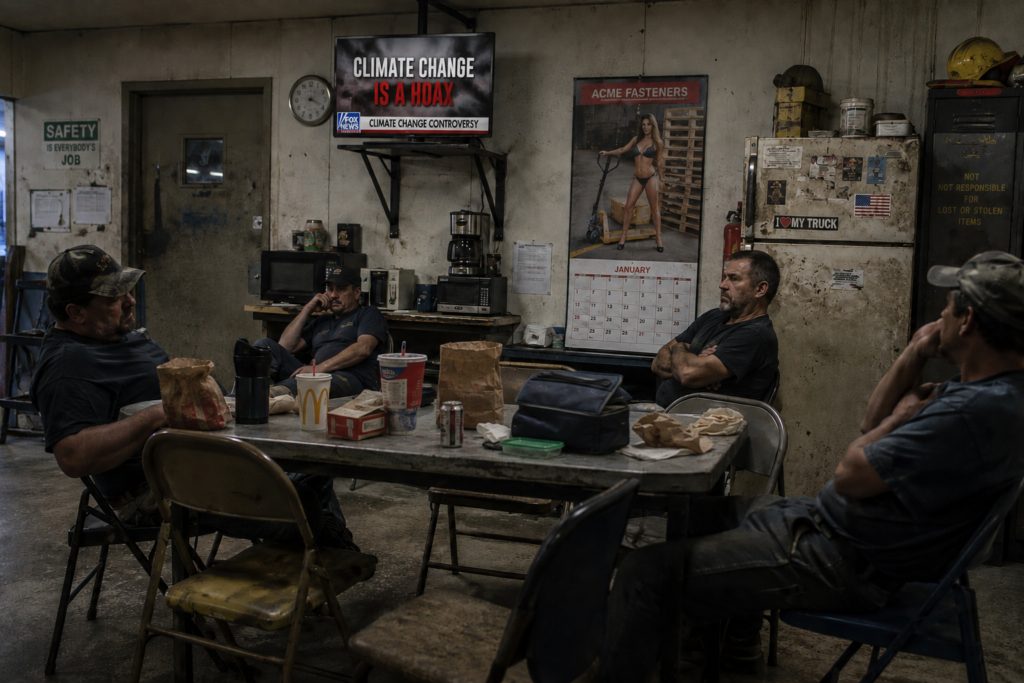
Scene one. The break room. Metal folding table, bolted-down TV playing the same sports channel it’s played since 2011. A calendar from a fastener supplier still hanging in January even though it’s June — a woman in a bikini leaning on a pallet jack, because apparently that’s how you sell pallet jacks. Somebody’s wife dropped off cupcakes for a birthday and a supervisor made a joke about “finally something a woman’s good for around here.” Nobody laughed hard. Nobody said anything either.
Scene two. The job posting. “Must be able to lift 75 lbs unassisted” for a role that requires it maybe twice a month, with equipment sitting six feet away that would do it in ten seconds. “Team player.” “Thick skin a must.” Everyone on the floor already knows exactly what that second phrase is really warning you about.
Scene three. The schedule. Twelve hours, rotating, no exceptions, because “that’s how it’s always been done.” The plant manager’s office, forty feet away, runs flex hours and works from home on Fridays.
None of this is a horror story. It’s not even unusual. It’s Tuesday, at a few thousand factories across this country right now.
THE CLIFF
Can you envision why manufacturing is having such a hard time attracting new talent?
Especially women, to fill the spots being left behind by a workforce that’s aging out fast. A quarter of the manufacturing workforce is 55 or older, heading for retirement in the next handful of years. The specific roles disappearing fastest to automation aren’t the ones going unfilled — it’s the skilled trades: machinists, electricians, controls techs, welders. Those are the jobs nobody can find bodies for. And women make up barely 4% of that skilled trades workforce, in an industry that needs to add hundreds of thousands more women just to replace who’s walking out the door.
So here are the three scenes above, playing out at a plant quietly losing its most experienced people, recruiting with a job posting that reads like a hazing ritual and a break room that tells any woman walking through exactly how welcome she’d be. Nobody has to be a villain for this to happen. It just requires nobody asking the obvious question out loud.
Let's ask it.
Would a 24-year-old woman with real mechanical aptitude — someone who fixed her own car in high school, who’s sharp, who wants a trade instead of $60K in student debt — ever apply here?
She wouldn’t. Not because she can’t do the job. Because she’d read that posting, maybe drive by, maybe even walk in for a tour, and get one look at that calendar and that break room energy, and decide the discomfort isn’t worth the paycheck. You’ll never see her application. You’ll just have one more req that sits open for eight months, and you’ll tell yourself “nobody wants to work anymore.”
And before anyone reading this decides this is only a women’s problem — it isn’t. Plenty of 24-year-old men wouldn’t touch that break room either. This generation has no patience for “figure it out yourself,” no tolerance for a culture built on who can take a joke, and zero interest in a job that treats “thick skin” as a job qualification.
The macho-plant playbook is losing its audience, full stop.
But here’s the actual difference, and it’s not about options — it’s about odds. A man walking away from one bad plant is dealing with one bad plant. The next one over might have a foreman he respects, a crew that treats him fine, nothing to overcome just for showing up. A woman walking away from one bad plant is usually walking away from the same 4% number, the same thin representation, the same odds of landing somewhere different — because the culture problem isn’t isolated to that one floor, it’s the industry average. That’s why women are still the sharpest opportunity in the room. Not because men are the problem and women are the fix — because the industry has never seriously tried to fix the one gap that isn’t a matter of luck.

HONESTY
Name it, or nothing changes.
Most plants that “have a culture problem” don’t think they have one. They think they have a “we’re just a tight-knit, no-nonsense team” problem, which is doing a lot of work to avoid the actual sentence: we built an environment that quietly tells half the population they’re not wanted here.
You cannot fix what you won't name.
Not with a poster in the break room about respect. Not with an annual harassment training video everyone clicks through while doing something else. Name it in a floor meeting. Out loud. “We’ve built habits here that don’t work anymore, and we’re going to change some of them.” That sentence alone will do more than six months of HR initiatives, because it tells your current team the standard is shifting — and it tells anyone new that someone in charge actually sees it.
THE POSTING
The job posting is already filtering her out.
Go pull your last five job postings for floor roles. Read them like an outsider. “Must lift 75 lbs unassisted” when the job has a hoist. “Rugged individual.” “Thick skin required.” “Family atmosphere” — which, depending on the plant, sometimes means “we all know each other’s business and we like it that way, newcomer.”
Rewrite them for the job that actually exists, not the job that existed in 1985. What’s actually required? What equipment handles the physical load? What does the role really demand day to day? Specificity attracts the right people and repels nobody who could actually do the work.
THE SELL
Nobody’s out there selling this job.
Ask a room of high schoolers what they want to be and you’ll hear nurse, teacher, software engineer, business owner. You’ll almost never hear “machinist” — not because the trade doesn’t pay well or doesn’t matter, but because nobody ever pitched it to them.
Manufacturing has spent decades being something people fall into, not something they choose.
Compare that to the marketing budget behind “become a nurse” campaigns — billboards, high school pipeline partnerships, signing bonuses advertised on Instagram. The plant down the street runs a listing on Indeed and calls a temp agency when nobody bites.
Temp agencies became the default because they’re fast and they make a headcount problem disappear on paper. But a temp badge tells a new hire something quiet and true on day one: you’re not quite one of us, and we’re not fully invested in you either. Ask any plant running 40% temp labor how loyalty is going down there. Turnover doesn’t stop because you filled the seat — it just gets a shorter fuse.
Companies that actually want to attract talent — women or otherwise — have to be willing to sell the job like it’s worth having. Real career paths. Real pay transparency. Real stories of people who started on the floor and now run a shift. Until manufacturing does that work, it will keep losing the best candidates to industries that at least bothered to ask for them.
FLEXIBILITY
Flexibility already exists at your plant. It just lives in the wrong building.
Here’s the part that gets me every time. Ask any plant manager if flexible scheduling is possible on the floor and you’ll hear “impossible, it’s a production line, machines don’t wait.” Walk into the same building’s front office and there’s flex start times, work-from-home Fridays, PTO nobody questions.
I’m not saying a CNC machine runs itself on a compressed schedule. I’m saying most plants have never actually tried to build one. Staggered shift starts. Job-sharing for specific stations. Predictable rotating schedules instead of “whenever we need you.” A four-on, four-off pattern instead of assuming everyone can do 12 hours, six days, no notice. An investment in a permanent ‘flexible’ workforce that can fill the gaps. These aren’t radical. Other plants are already doing them and are the ones actually filling their reqs.
Flexibility isn’t a women’s issue. It’s a caregiving issue, and caregiving still disproportionately falls on women — which means “no flexibility” quietly becomes “no women,” without a single sign of it in your hiring data explaining why.

DEI
What it actually means, minus the baggage.
I’ll say this plainly because the phrase has gotten so loaded it’s stopped meaning anything: this was never about lowering the bar. It was never about hiring someone less qualified because of what they look like.
It means noticing where your hiring process has an artificial wall in it that has nothing to do with whether someone can do the job — and taking the wall down. That’s it. A “must have 5 years experience” requirement for an entry-level apprenticeship. A referral-only hiring pipeline that only reaches the people already in your network, who all look like you. An interview panel that unconsciously scores “confidence” higher when it sounds like their own.
Take the wall down, and you're not lowering your standard. You're finally applying it to everyone instead of a quarter of the available population.
But taking the wall down only gets someone in the door. Finding her isn’t the finish line — it’s the starting gun. Once you’ve actually hired outside your usual mold, what happens on the floor her first ninety days decides whether she stays. That takes a real blending strategy, not good intentions.
THE BLEND
Blending the old guard with a generation that wants something different.
This starts with management, not chemistry. Leadership has to build an actual plan, process, and culture for how two very different generations work together — not assume good people will just figure it out on their own. Set expectations for both sides up front. Check in early and often. Step in fast the first time old habits start undercutting a new hire instead of teaching her. Without that structure, you’re not blending anything — you’re just hoping friction resolves itself, and it won’t.
Here’s why the effort is worth it. Your veteran floor lead is 58, been there 30 years, trained by someone just as old-school, communicates in grunts and nods and “figure it out.” Your newest hire is 23, wants to understand why before she does something, expects feedback more than once a year, and will absolutely ask “why do we do it this way” out loud in her first week.

That collision is not a culture clash to survive. It’s the actual asset — if leadership sets it up on purpose. Pair them deliberately instead of by accident. Let the veteran teach the trade skill. Let the newer hire teach him that explaining the “why” once actually makes people faster and safer than assuming they’ll pick it up eventually. Reverse mentoring isn’t a corporate buzzword invented for tech companies — it works exactly as well on a factory floor, if management actually builds the conditions for it.
Left to chance, it doesn’t happen. Not on a floor that’s operated the same way for 30 years. Buy-in from leadership isn’t a nice-to-have here — it’s the difference between a mentorship pairing that builds loyalty and one that quietly confirms every reason she had to walk out the door.
LOYALTY
The loyalty question.
Loyalty runs both directions, always has. You want people who show up, who stay, who care whether the line runs well. That loyalty has to be earned before it’s expected.
Ask yourself honestly: if a sharp young woman walked your floor tomorrow, would she see a place worth being loyal to — or a place she’d be counting the months until she could leave?
Your retirement wave doesn't care about your excuses. It's coming regardless.
The plants that fix this now get first pick of the people everyone else is about to be desperate for. The rest will spend the next decade wondering why the reqs won’t fill.
🏭 Factory Floor Forward
Ready to build a better factory floor? Progress happens when leadership and workers trust each other enough to build it—together.